

In 2009, Lynne McTaggart sat down with her husband to watch a BBC documentary called Did Darwin Kill God? Towards the end, Simon Conway Morris, the Cambridge palaeobiologist, made an observation that hit her, in her words, like a brick. There is a deep underlying order to the universe, he argued. Take music. Animals have music nearly identical to ours: humming, drumming, even duets. Suppose there is a universal music out there. That would mean it is something pre-existing.
This one rewards proper listening. Headphones, a quiet room, and let the examples land
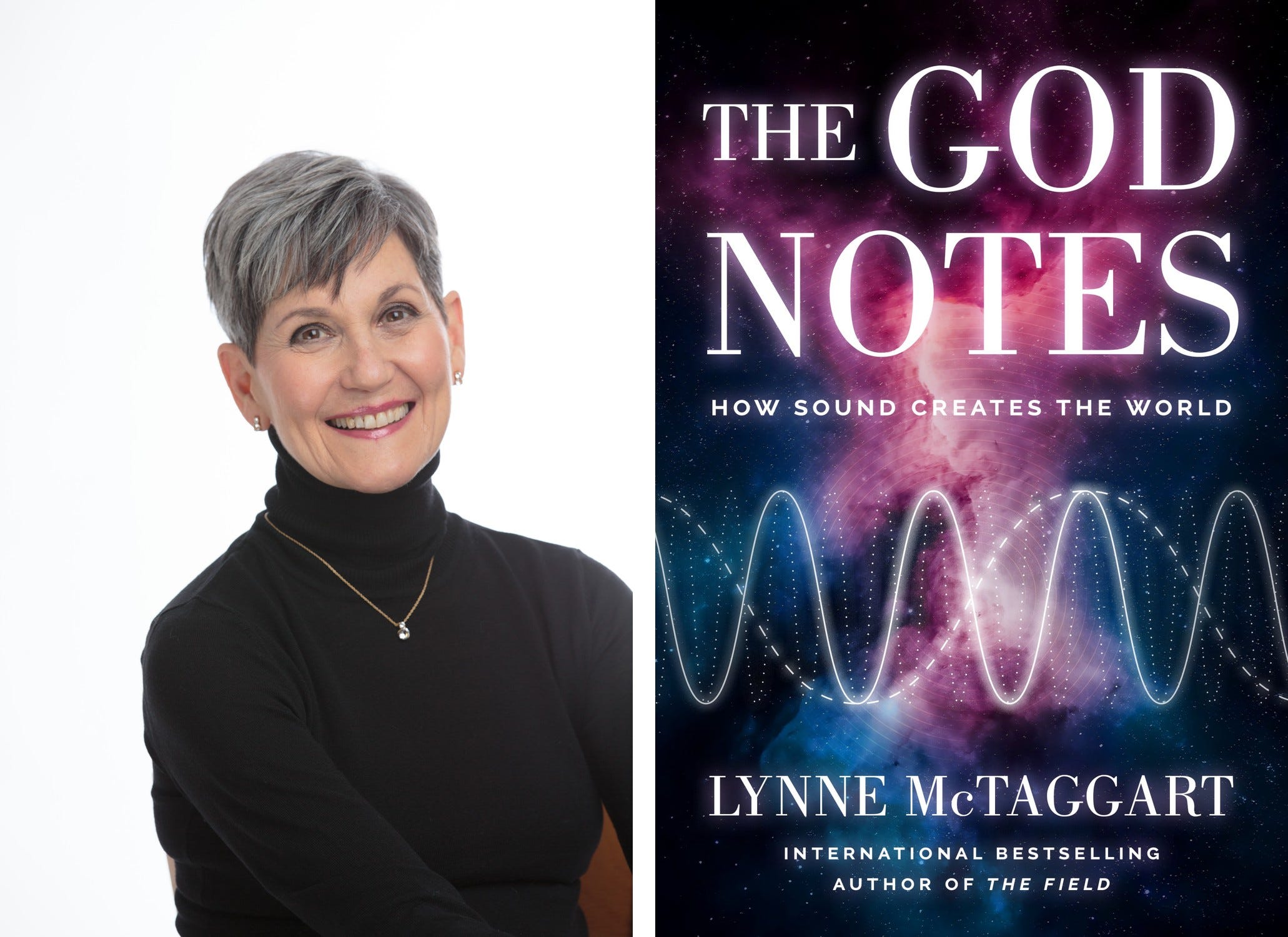
She wrote down two words, universal music, and kept a folder under that name for fifteen years. Whatever she found about music went in. The God Notes: How Sound Creates the World, published by HarperOne on 20 October, is what that folder became, and when Lynne returned to Together We Rise ahead of the launch, she described it the way she describes all her books: as a detective story whose ending she did not know when she began.
A Cinderella energy
Sound, she told me, has been treated as a Cinderella energy. “It was there; it’s always been there, but it’s been relegated.” Entertainment, communication, background. Steven Pinker famously dismissed music as auditory cheesecake, a pleasant by-product of more serious faculties. Lynne knew it was more than that. The shiver down the spine that certain music produces felt to her like recognition of something greater than ourselves.
So she went looking, and she went looking in the most conventional places. She interviewed scientists at MIT, Cambridge, Harvard, Oxford and UCLA, and the back of the book carries a thick bibliography of their papers.
“There was no woo-woo here, even though the implication is hugely woo-woo.”
Each of them, she found, was discovering something extraordinary about the world, connected to everything else she was discovering, and hiding in plain sight.
The body is an orchestra
When I asked her where metaphor ends and mechanism begins, her answer was immediate: “I’m not being metaphoric.”
Our cells make sound. James Gimzewski, a professor of chemistry at UCLA, built equipment sensitive enough to record them, and found that healthy cells make one sound while stressed cells make another, more screechy one. At MIT, the materials scientist Markus Buehler went after the protein folding problem, the question of why proteins constantly somersault, stretch and fold. Knowing that amino acids vibrate at characteristic frequencies, he raised them into the audible range, kept every interval intact, and fed the result to an AI orchestra. Out came music. The enzyme lysozyme emerged as melodic jazz. The Covid spike protein sounded like a Japanese orchestration, and it carried counterpoint, two interwoven melodies augmenting one another, the device on which Johann Sebastian Bach built The Art of Fugue. Buehler went on to find counterpoint in every protein he tested, then reversed the procedure and turned a Bach composition into an actual protein. “Our bodies are literally making music,” Lynne said.
Nor are we alone. Whales carry elements of grammar in their songs. Japanese researchers testing preferred beat frequency found that rats nodded along to Lady Gaga’s Born This Way and Queen’s Another One Bites the Dust at the same tempo range we favour, and bopped to Mozart besides.
The musical key
Then came the discovery she called the most mind-blowing of the book. Alan Turing, remembered for breaking the Enigma code, also created a simple mathematical formula describing how repeating patterns form in nature: a chemical stop-start mechanism behind zebra stripes, flower petals, even crime hot spots. Decades later the neuroscientist Selen Atasoy, mapping the harmonics of the human brain at Oxford, found that the brain behaves like an orchestra. At rest it plays something gentle and repetitive, closer to Philip Glass; in a burst of creativity, or on a psychedelic, it becomes Miles Davis in full improvisation. And when she went to describe it mathematically, Turing’s formula fitted the brain too.
If flower petals, zebra stripes and brains all answer to the same mathematics, Lynne argues, you are no longer describing coincidence. You are describing a key.
“There is no way this could be random.”
Her conclusion is bold: a deeply ordered, unified, intergalactic sonic superorganism, which sits very uncomfortably beside the neo-Darwinian story of accumulated accident. She is careful about what follows. Even Conway Morris, she notes, points to convergence, the way an octopus and a human arrived separately at the same camera eye, as evidence that evolution runs along grooves rather than tumbling at random.
What sound can already do
I asked what she would replicate first, given an independent laboratory and unlimited funding. She began with cancer. In preliminary studies she gathered for the book, breast cancer cells responded badly to Beethoven’s Fifth, to Ligeti’s atonal Atmosphères, familiar from 2001: A Space Odyssey, and to heavy metal. One application has already crossed into approved medicine: histotripsy, which uses focused sound at frequencies far above a pregnancy scan. Her description of why it matters is the best I have heard. Cancer, she said, is like a thief in the night. It enters the building illegally, switches off the alarm system, which is the immune system, and runs riot through the house. Histotripsy opens the outer membrane of the cancer cell so the alarm system can finally see the intruder. It is not the sound that kills the cancer; it is the immune system, at last doing its work. The technique is approved by the US Food and Drug Administration for liver cancer, and Lynne cites Jeremy Clarkson’s recovery from prostate cancer this year as a sign of where the field is heading.
She would fund sound against fire too: a California company has trialled frequencies that, as she describes it, deprive a flame of the oxygen it needs. And she told me about the sound healer Dr. Jeffrey Thompson, a chiropractor who tests which notes work for which person, and about a little boy whose epilepsy was so severe that his parents had him wear a crash helmet. Twenty fits a day fell to fifteen, then ten, then five, then none, after weeks of listening to a CD of notes Thompson prepared for him. Sound healing, she insists, deserves exploration as a modality in its own right, not relegation to feel-good background music.
The sounds we cannot hear
My own question came from the built environment, where I have spent my working life: if sound and rhythm are intrinsic to our biology, then no building is acoustically neutral. What should we measure, beyond decibels, to understand what a space is doing to the nervous system?
Her first answer startled me: our ears contain immune system cells. They are not only hearing to hear; they are hearing to heal, or to be harmed. Our audible band runs from 20 to 20,000 hertz, and below it lies infrasound, which she argues is routinely dismissed because the equipment used to measure it is nowhere near sensitive enough. Wind turbines, in her account, operate partly in that hidden band, and so do winds themselves. Californians have always said the Santa Ana winds make people crazy; Raymond Chandler wrote of meek little wives fingering the carving knife and studying their husbands’ necks when the Santa Anas blow. The same is said of the Mistral in France. It is not the wind, Lynne says. It is the infrasound riding on it.
This is precisely the territory of nervous system compliant design, the standard I have argued for: buildings measured by what they do to the people inside them. A space is speaking to the body all day long, whether or not the mind notices.
The pyramid and the blood
Two chapters of the book belong to John Stuart Reid, the acoustics engineer and pioneer of cymatics, a colleague of mine on the board of the CymaScope Institute and a past guest on Together We Rise. On his third research expedition to the Great Pyramid, measuring the resonant frequencies of the King’s Chamber, John arrived with his back in such severe spasm that he could not bend or lift his own equipment. In the middle of the experiments he realised he had been bending freely, without pain. The pain did not return that night, or the next day, or ever.
That experience sent him towards the body, and towards an experiment he designed with Professor Sungchul Ji, a cell biologist at Rutgers and the father of GreenMedInfo founder Sayer Ji, a connection that runs close to home for this podcast. Red blood cells do vital work and live only briefly, so the two of them asked whether music could extend their lives. Batches were kept in quiet or exposed to different pieces. The winner was not Tchaikovsky, and not the Ode to Joy. It was a techno beat under a low female voice. Think of Cher’s Believe. The materials accompanying the book report that samples exposed to twenty minutes of music held up to 23 times more living red blood cells than samples kept in silence, and Lynne’s guess at the mechanism is disarmingly simple: a red blood cell spends its whole life listening to a loud, regular beat. We call it the heart.
She added one finding with a smile: among the cells that respond worst to certain notes are fat cells. We may not need Wegovy and Mounjaro, she said. We may just need the right note.
In the beginning was the note
We are musical with one another too. In the 1980s, William Condon slowed down film of a family at dinner and found every blink, nod and lifted spoon synchronised to the mother’s voice, as though a drummer were keeping time behind them. Edward T. Hall filmed children in a playground moving so rhythmically that scientists assumed they were dancing to a song added afterwards. Even strangers reading a script aloud fall into synchrony within seconds. We are hardwired for it, which is why Lynne keeps returning to the line she gave me in our first conversation: we need belonging and connection more than we need to breathe.
And the music does not stop at the edge of the body, or of the planet. Black holes emit the lowest B flat in the universe, 57 octaves below middle C, and astrophysicists at NASA and Cambridge now believe that note contributed to the growth of entire galaxies. The sun’s sounds are implicated in creating its heat. The doughnut-shaped geomagnetic shield around the Earth is plucked by sound almost like a heart, with effects on the two great engines of the human body, the heart and the brain. In the beginning was the Word, Lynne said, reaching for the opening of the Gospel of John, and then corrected herself.
“In the beginning was the note.”
Aum, the primordial sound
Lynne’s correction to the Gospel, in the beginning was the note, is one I have known in another language for most of my life. In the Vedic tradition the first sound has a name. Aum, often written Om, is the vibration from which all creation is said to arise, the sound that stands for Brahman, the ultimate reality. The Upanishads do not treat it as a word about the universe. They treat it as the universe. “Om is all this,” the Mandukya Upanishad begins: everything past, present and future, and whatever lies beyond time.
The same Upanishad divides the syllable into three. A is the waking world, U is the dreaming mind, M is deep and dreamless sleep. Then comes a fourth, turiya, which has no letter at all: the silence after the sound fades, where pure awareness rests. Chant Aum slowly and you pass through all three states and arrive, for a moment, in the fourth. It is a map of consciousness you can hold in a single breath.
India built whole philosophies on this insight. Nada Brahma, the phrase goes: sound is God, or the world is sound. The grammarian Bhartrihari, writing some fifteen centuries ago, called the ground of reality Shabda Brahman, the absolute as sound. Nada yoga distinguishes ahata, the struck sound we make with voice and instrument, from anahata, the unstruck sound, a vibration with no cause that practitioners say can be heard in deep stillness. Anahata is also the name of the heart chakra. I find it moving that the tradition placed the unstruck sound at the heart, and that Lynne’s best guess for why red blood cells thrive on a steady beat is that they spend their whole lives listening to one.
This is not abstract for me. Chanting has been part of my practice for years, and my kirtan training with Radhika Das, a past guest on Together We Rise, and Keli Woods taught me what the texts describe: a room of people singing the same syllable stops being a room of separate people. William Condon would have recognised it at once.
Science is beginning to listen. In a small pilot study published in the International Journal of Yoga in 2011, researchers in Bangalore scanned volunteers with fMRI while they chanted Om and found deactivation in limbic regions linked with fear and stress, a pattern they compared with vagus nerve stimulation, a treatment used for epilepsy and depression. Simply humming, researchers at the Karolinska Institute reported in 2002, raises nitric oxide in the nasal passages around fifteen-fold. These are early findings, not proof of the Upanishads. But they point the same way as everything Lynne gathered: the sounds we make are also making us.
When I offered Lynne this oldest version of the idea, she met it without hesitation. Pythagoras was right about the music of the spheres, and the ancients were right long before him. The late Robert Jahn, dean of engineering at Princeton, tested six thousand year old chambers across Britain and Ireland, wildly different in shape, and found them all resonating at essentially the same frequency, around 110 hertz. The UCLA neuroscientist Ian Cook later confirmed that 110 hertz shifts brain activity away from logical processing and towards the region associated with transcendence. At a conference we both attended this summer, Lynne put the room into groups and played 110 hertz; people described the deepest states they had known. She and her husband Bryan felt it themselves in an ancient structure in Sardinia, toning the frequency with the archaeoacoustics researcher and medical doctor Paolo Debertolis.
“Science is catching up with what the ancients understood,” she said. The God Notes is her case that the catching up has begun in earnest.
It would be easy to hear all of this as wonder. I heard it, as I always do with Lynne, as method. Follow the clue. Keep the folder. Talk to the scientists. And when the evidence assembles itself into a symphony, have the nerve to say so.
I’ll leave you with one question. Which piece of music gives you that shiver down the spine, and what do you now suspect it has been telling you all along?
Join the conversation
If you are already a subscriber, thank you. You are the reason these conversations exist, and you are also how they travel. If something here gave you that shiver, please share it with one person who listens to the world the way you do, and tell them why.
The comments are open to everyone, not only subscribers. Answer the question above, ask the question you wish I had asked Lynne, or tell us about a place where you have felt sound change you. Your questions help shape who and what we explore next.
Keep listening
If this conversation opened something for you, these will take you further:
Lynne McTaggart, our first conversation with Lynne on Together We Rise
John Stuart Reid, the acoustics engineer and pioneer of cymatics whose work fills two chapters of The God Notes
Radhika Das, on kirtan and the devotional power of sacred sound
Pam Gregory, on unity consciousness
The Woman Everyone Relies On, with Karen Heras-Kelly and Lucy Barkas
You can find every conversation in the Together We Rise archive.
About the book. The God Notes: How Sound Creates the World is published by HarperOne, an imprint of HarperCollins, on 20 October 2026 (hardcover, ebook and audiobook; ISBN 9780063424111). Order it at lynnemctaggart.com/books/the-god-notes or on Amazon. If you buy the book, you can also join Lynne’s free webinar on 7 November, where she will teach some of the God Notes themselves.
About Lynne McTaggart. Lynne McTaggart is an award-winning investigative journalist and the author of eight books, including the international bestsellers The Field, The Intention Experiment, The Bond and The Power of Eight, as well as her newest book, The God Notes: How Sound Creates the World. Her work has been published in approximately 30 languages. She is the architect of the Intention Experiments, a web-based global laboratory exploring the effects of collective human intention, and the creator of the Power of Eight methodology. Her work has featured prominently in documentaries, including Gaia’s two-part production The Power of Intention, and inspired part of the storyline, and a character, in Dan Brown’s novel The Lost Symbol. Lynne is also co-owner and editorial director of What Doctors Don’t Tell You. Her journalism and writing have received numerous honours, including the New York Women’s Press Club Award of Merit, London Times Columnist of the Year, Spiritual Writer of the Year and Champion of Change. She lives in London with her husband, author and publisher Bryan Hubbard.
Show notes
00:00 A folder marked universal music: Did Darwin Kill God? and Simon Conway Morris
03:52 “The universe is not matter; it’s music”: what to take literally
04:26 Singing cells and the protein orchestra: James Gimzewski and Markus Buehler
09:34 Turing’s patterns, Selen Atasoy and the musical key to the universe
15:47 What she would test first: cancer cells, histotripsy and putting out fires with sound
21:09 Dr. Jeffrey Thompson and the boy with epilepsy
22:35 Buildings are never silent: infrasound, wind farms and the Santa Ana winds
25:44 John Stuart Reid: the Great Pyramid and the blood experiments
33:00 Falling into time: interactional synchrony and belonging
35:47 The sonic superorganism: black holes, the sun and the geomagnetic heartbeat
41:35 110 hertz: ancient chambers, Sardinia and the God Notes
44:24 The book, the launch and the free webinar
Find Lynne
The God Notes: lynnemctaggart.com/books/the-god-notes · Amazon (out 20 October; buying the book unlocks the free webinar on 7 November)
Website: lynnemctaggart.com
Instagram: @lynnemctaggartofficial
What Doctors Don’t Tell You: wddty.com
From our archive: Lynne’s first conversation on Together We Rise · John Stuart Reid on Together We Rise

In response to your "Which piece of music gives you that shiver down the spine,", I'd have to answer Pachelbel's Canon in D. The first time I heard it, it was playing on the intercom as I was walking through a big box hardware store. I was immediately frozen, mesmerized, and unable to walk while immersed in the intense beauty of the composition. Now, even years later, I find that I cannot do anything else while it is playing. It has always "done something to me" that seems to immobilize me, and maybe force me to keep listening!
Can you please share which music Jeremy Clarkson used for his prostate cancer healing? Thank you!