

Before we recorded a word, John Stuart Reid asked me for a crystal.
It was raining in London, the tea was still steeping, and the crystal I handed him was a Lemurian quartz from Mount Shasta. He held it between finger and thumb, and squeezed. Inside quartz, he explained, the atoms sit in a hexagonal lattice, and their electrical charges are not quite evenly placed. Deform that lattice, even slightly, and charge separates. Pressure becomes electricity. Wrap the crystal in copper wire, connect it to an oscilloscope, and speak: your voice appears on the screen as a waveform. Talk to a crystal and it answers in current.
The same principle, he continued, runs through us. The myelin that sheathes our nerves, the collagen of our fascia and bone: these tissues have piezoelectric character too. Bone’s is textbook physics; the fuller picture of the body as a liquid crystal medium is a younger field, still being drawn. But the image holds. Each breath deforms the body’s living lattices by a fraction, and a fraction is all piezoelectricity requires. We generate a whisper of electricity every time sound, or movement, passes through us. That was before the cameras. Then we spoke for nearly two hours, and did not stop once. Watch the video below.
Sound made visible
John has spent five decades in acoustics and is best known for the science of cymatics: making sound visible. The lineage he traces begins around 1800 with Ernst Chladni, a German musician and physicist who bowed the edge of a metal plate sprinkled with sand. Sound deformed the plate into hills and valleys too subtle for the eye, and the sand migrated into the valleys and drew the geometry out. Napoleon, watching, was transfixed enough to fund a prize of three thousand francs for a mathematical explanation. It was won by Sophie Germain.
Two centuries on, John’s CymaScope replaces the metal plate with something far more sensitive: the surface of water. Sound imprints its pattern there invisibly, the way a fingerprint sits unseen on glass, and where a detective would dust powder, his instrument, in his phrase, sprinkles on dust of light. Under that light, trillions of water molecules abandon their random Brownian jostling and settle into geometric order. Harmonic sound, in which every frequency stands in mathematical ratio to the others, always produces beauty. Dissonance produces skew and chaos. The adage of the laboratory is simple.
Beauty in equals beauty out.
The first time I visited his laboratory, he handed me a microphone and I said the word love into the water. What came back was a form I can only describe as a signature. And the signatures go all the way down. In 2002, Professor James Gimzewski at UCLA used an atomic force microscope to listen to living cells and found that every type of cell sings its own song. With Professor Sungchul Ji, John has made those songs visible: the cymaglyph of a healthy cell symmetrical and exquisite, the cymaglyph of a cancer cell skewed and disordered. Their study is published, and both believe this line of work points towards new ways of detecting, and one day confronting, cancer. Gimzewski predicted as much more than twenty years ago.
The dose is the medicine
Every energy in nature heals or harms by dose. Twenty minutes in a mild British sun is a gift; an hour is a burn. Sound obeys the same law, and John gives it numbers. Stand before a waterfall and let the sound meter on your phone read 85 decibels: you are at the upper edge of what heals. Between 75 and 85, the broadband roar of white water is deeply restorative. At 90, cells begin to defend themselves rather than receive. At 95 or 100, damage begins. The same arithmetic applies in front of a speaker stack at a concert, and the instrument for checking it now lives in every pocket.
What makes natural sound so generous is its breadth. A waterfall, waves on a shore, psithurism, the old word for wind moving through trees: each carries thousands of frequencies, from infrasound below hearing to ultrasound above it. And breadth matters because of the songs. Every cell sings at hundreds of frequencies, and nobody yet knows which frequencies belong to which cells; the research Gimzewski began has not been carried forward, and the instruments it needs are expensive. So John refuses the shortcut of a single magic number. The honest protocol is immersion in breadth, at a safe level, letting each cell take up the frequencies that belong to its own song and let the rest pass. It is why he ranks the gong, a metre of ringing metal and thousands of frequencies, among the finest of instruments, alongside the piano, the harp and the Tibetan bowl.
How the body listens
I came to sound through buildings. My research interest is what I call nervous system compliance in the built environment, and I notice that the rooms in which I feel most regulated are the ones that sound like nature, or like nothing at all. So I asked John the question underneath all of this: how does the body listen?
His answer begins in Copenhagen. In 2005, researchers at the Niels Bohr Institute proposed that the nerve impulse travels not as a simple electrical signal but as a density wave, a pulse with more in common with sound than with current. The clue was speed: a signal from stubbed toe to brain takes milliseconds, orders of magnitude slower than electricity should allow. John’s reading goes further. Nerves, he says, conduct sound, and the piezoelectric myelin wrapped around them turns that mechanical pulse into electricity along the way. The free nerve endings at the surface of the body pick up sound directly; every nerve in you soaks up the waterfall, not only the ear.
Then there is the ear itself, and the strangest wiring in the body. The vagus nerve leaves the brainstem and travels first, before lungs, heart or gut, to the outer ear, with most of its endings gathered in the tragus, the small flap over the ear canal. Hearing does not need it; the cochlea has its own connections entirely. So why route the body’s great regulating nerve to a pair of small parabolic dishes turned towards the world? John’s hypothesis, offered as hypothesis, is that nature wired the ear to the vagus so that the sounds of the environment could keep vagal tone tuned. The next stops on the nerve’s journey are the pharynx and larynx, which means that to speak, chant or sing is to stimulate your own vagus from within. Then the lungs, so every breath contributes. Then heart, liver, kidneys, gut.
This matters because of what vagal tone appears to govern. Mainstream medicine, superb in acute crisis, has a thin toolbox for chronic inflammation, and John points to a growing body of research linking optimal vagal stimulation to its reversal. The studies he cites converge on an optimal range of five to ten hertz, below the threshold of human hearing. When he examined the soundscapes of nature on a spectrum analyser, he found most of their energy concentrated exactly there, in the subaudible. Nature, as he puts it, pointing at where the energy needs to be.
The frequencies that are not on the record
Which brings us to a mystery that arrived at breakfast. John and Annaliese often begin the day with Dream of the Blue Whale, an album by their friends Anders Holte and Cacina Meadu: Anders mimicking the vast slow song of the whale, Cacina laying down long dreaming chords. Curious about how low Anders could sing, John ran the album through his analyser and found energy at four and five hertz. This should have been impossible twice over. No human voice reaches anywhere near it, and recordings are routinely mastered with everything below twenty hertz removed, because speakers cannot handle what lies beneath.
The frequencies are not on the record. They are made for us, in real time, in the electrical domain of the player, by a phenomenon called heterodyning: frequencies mixing to create new ones. It is a commonplace of electronics and, until John began asking colleagues around the world, apparently unremarked in acoustics. Only certain albums produce the effect, and he does not yet know why; one theory about mastering, offered by his colleague Jonathan Goldman, was tested against the list and set aside. The list itself is freely given, and we will share it alongside this conversation.
The practice that follows is disarmingly modest. Wired headphones whose specification genuinely begins at five hertz, such as the Beyerdynamic DT 770 Pro; earbuds, wireless and bone conduction models all roll off at twenty hertz and will not do. For chronic inflammation he would suggest one full album in the morning and another in the afternoon, none in the evening lest the vagus be tuned too bright for sleep, sustained over weeks. You cannot, he notes, overdose on music.
And the twenty minutes? That number comes from blood. In 2018, John and Professor Ji began a series of experiments in which donated human blood was divided between a silent, electromagnetically screened Faraday cage and an incubator fitted with a small speaker. Twenty minutes of music raised the viability of red blood cells, the ratio of living to dead, by ten to twelve per cent, against no change at all in the control. New cells for old, as John says, borrowing from Aladdin. The study is expected to publish this year.
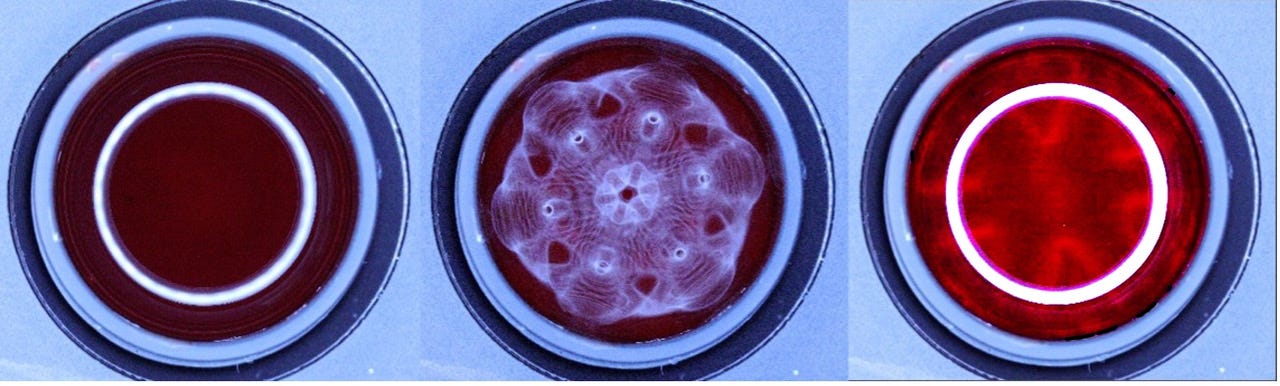
Quiescent blood (left), hexagonal 44 Hz sinusoidal tone-induced cymaglyph (center), Stationery hexagonal geometry elements, after removal of the 44 Hz tone (right), after removal of the 44 Hz tone. The contrast has been enhanced in the right image.The internal diameter of the fused quartz cuvette is 23 mm, and the volume of blood was 2.3 ml. The white circles in the left and right panels are reflected light from a light ring, consisting of 34 light-emitting diodes, arranged above the cuvette and coaxial with it.
Add the second mechanism, dopamine, the reward chemistry of doing what you love, with its documented lift in white blood cell counts, and a picture forms of music as a therapy with two hands. Though John would correct the word therapy before I finished the sentence. He dislikes the term sound healing, because it implies the healing arrives from outside. Sound, light, frequency: these are catalysts. They remind the body of its own work.
Only the body can heal itself.
Granite that remembers
Every conviction in this conversation has a root, and John’s is granite. In 1996 he lay in the sarcophagus of the Great Pyramid’s King’s Chamber, hands crossed on his chest like a pharaoh, and made sound. At one pitch, later measured at 117 hertz and known to him ever since as the Goldilocks frequency, every cell in his body seemed to tingle. He returned that year with instrumentation and mapped the sarcophagus frequency by frequency. At 117 hertz the granite box, in his words, just about took off. A few hertz beyond a second peak, the whole sarcophagus began to beat like a heart, powerfully enough to alarm the antiquities inspector across the chamber.
In 1997 he went back to attempt something no one had tried: a cymatics experiment inside the pyramid. A membrane stretched over the sarcophagus, tensioned evenly with small measured bags of sand, a speaker set within, sand sprinkled on top. He expected circles, because sound propagates spherically and a cymaglyph is a cross section through the sound bubble. Instead, at the first frequency, a hieroglyph appeared in the sand. Then, at other frequencies, more. The inspector, who had been filing his nails against the north wall, ran over asking how, then joined the work, brushing the membrane clear between tones. And after twenty minutes of this, John noticed something else. The severe back injury he had carried for three weeks, dosed with analgesics just to make the trip, was gone. He assumed the natural opioids of excitement and waited for the pain to return at the hotel. It never returned at all.
He offers his explanation for the hieroglyphs with the humility it deserves, as a notional hypothesis resting on synaesthesia, the cross wiring of the senses. Sound entering the cochlea imprints its pattern on the tectorial membrane; in most of us, most of the time, the perception of that pattern is muted. At the edge of sleep, John’s own muting lifts, and a sudden sound shows him a monochrome rose window behind his eyes. Now place a synaesthetic scribe at ancient Nekhen around 3200 BCE, where the Narmer Palette preserves some of the earliest hieroglyphic writing and where masons had just begun to work granite, a stone that rings like a bell under the tool. Suppose he saw the sounds as his colleagues struck the stone, and wrote them down: this one the backbone of Osiris, that one the loop of protection. It would mean that when John excited granite with sound five thousand years later, the stone gave back the shapes a scribe once saw. It would mean the hieroglyphs are, in part, a record of what granite sounds like.
I told him something on the recording that I had never said publicly. When I shifted my own practice from spoken prayer to toning Om, slowly, in two tones, I began to see geometric forms behind my closed eyes. I had assumed it was only me. It is not.
The road leads next to India. In the Barabar hills of Bihar, more than two thousand years ago, unknown craftsmen cut chambers into solid granite and polished the walls to optical flatness, flat enough that a priest standing in the doorway is mirrored in the stone. From an acoustics engineer’s standpoint there is exactly one reason to build such flatness: reverberation. Where the King’s Chamber sustains a sound for roughly five seconds, the Barabar chambers are reported to sustain one for sixty. John intends to measure that himself, and to bring the CymaScope Lite, the first portable instrument of its kind, into the chambers: to make sound in that granite, project the emerging cymaglyphs onto the walls, and set them beside the mandalas of India’s temples, whose circular geometries the cymaglyphs so strongly resemble. We intend to make that journey together.
The commons of sound
Near the end, I asked what the ancients understood experientially that we are only beginning to measure, and his answer quietly moved the whole conversation from the laboratory to the dinner table. A room full of ordinary conversation, he pointed out, runs at something like eighty to eighty five decibels. Everyone speaking is stimulating their own vagus through the larynx; everyone listening is receiving the room through the pinna; everyone present is, unwittingly, contributing to everyone else’s healing. Add the chemistry. Vocal frequencies between one and two kilohertz excite the paranasal sinuses through Helmholtz resonance, the physics of air held in a cavity, and the sinuses respond by releasing nitric oxide, which dilates blood vessels and carries oxygen deeper into tissue. The lungs do the same near one hundred to one hundred and fifty hertz. Song, chant and speech summon the body’s own pharmacy, in company.
The ancients seem to have held this knowledge as practice long before anyone held it as mechanism. In Lise Manniche’s Music and Musicians in Ancient Egypt, John found a line of ritual that stopped him: the sistrum, that high shimmering rattle, presented to the nostrils of the celebrant, that it may provide the rejuvenating breath. He has tried it on himself, and the feeling arrives in the spine. Three thousand years before nitric oxide had a name, someone noticed what happened at the nostrils when the high frequencies rang, and made it liturgy.
His vision for humanity, when I asked for it, was not a technology. It is a world in which cymatics is common knowledge, in which the average person needs no lecture to know that sound is doing things in the body, theirs and everyone’s within earshot. Which returns me to the question I carried into this conversation and will carry out of it.
If we truly understood that every voice physically enters and affects the world, would we speak differently to one another?
The evidence will take the time that evidence takes; some of it publishes this year, and some waits on granite in Bihar. The practice is available now, and costs almost nothing. Twenty minutes beside white water. An album you love through honest headphones. A conversation held at the level of a waterfall. We are instruments in rooms full of instruments, and John said the last word better than I could, so I will leave it with him: through that process, together we rise.
The crowd that funded Pythagoras
There is a chapter behind those blood experiments that deserves telling, because it says something about how this kind of science gets done at all. When Napoleon watched Chladni’s sand find its geometry, he endowed a prize of three thousand francs. When John proposed, in 2017, to test whether music could influence the longevity of human blood cells, no emperor was watching, and no institution was ever going to pay. Sayer Ji of GreenMedInfo named the reason plainly at the time: sound can be given away for free, and it will never be patentable. A therapy no one can own is a therapy no one will fund.
So the funding came from readers. Emily Abbey of roadmusic, whose own encounter with a rare blood condition had led her to wonder what music does to blood, brought the question to John, who had been quietly circling the same experiment from the other side. Together with Sayer they launched the project on the science crowdfunding platform Experiment, under a premise borrowed from Iamblichus, who recorded that Pythagoras used music in the place of medicine, a claim that in two and a half thousand years had never once been put to the test. Two days before Christmas, Sayer carried the appeal to the GreenMedInfo community: a few hundred supporters, a few dollars each. By the second week of January 2018 the project stood at 103 per cent of its goal, 284 backers strong, and the laboratory had its incubators, its cell counter, its supplies of blood and reagent.
Music in the place of medicine.
And here the story folds into family. The Professor Ji whose collaborations run through this piece, and who formally endorsed the project at its launch, is Sungchul Ji of Rutgers, the father of my partner, Sayer. So when I sat down with John in London, I was not only interviewing a scientist; I was picking up a thread that runs through the people I love. When the blood study publishes this year, its acknowledgments will belong in part to a crowd of readers who decided, nearly a decade ago, that a question first asked in ancient Greece deserved an answer.
With gratitude to John Stuart Reid, acoustic physics researcher and inventor of the CymaScope, and to Annaliese Reid. Gratitude also to Professor Sungchul Ji, whose collaborations run through this work, and to Anders Holte and Cacina Meadu, whose music carries frequencies that are not on the record. Explore John’s work at cymascope.com; the CymaScope app is available for iOS and Android; the album list for optimal vagal stimulation is linked with this episode.
Together We Rise is written and published by Dr Tia Kansara. togetherwerisepodcast.substack.com | replenish.earth

Absolutely fantastic info! Thank you, and thanks Sayer for sending it out to us. I am familiar with Dr. Reid through his collaboration with Dr. Gary Buchanan of the Steamboat Hotsprings Spa in Reno, NV, who introduced me to Cymatics years ago, and Dr. Guy Manners, who pioneered much of cymatic healing. One question please: can the recordings of Anders Holte on YouTube produce these effects or does one have to use the album recording? (AMZ says it's "unavailable"). And I'd like to know before I spend the money for headphones with a 5 hz low range! Or can you provide info for purchasing the CD? Thanks again!
Thank you. I cannot see the list of albums that you mentioned would be available to experience the low frequencies such as from Jonathan Goldman. I had it a few years back and misplaced it. Could you post it here please or send a link. Also as a less expensive set of headphones the Sony YY2981 is stated to go from 5-20,00 Hz. Geoffrey Blake